
Homeowners' pick for heating and cooling across central Kentucky and the Bluegrass
Which Heat Pump Faults Are Worth Fixing
Your heat pump is short cycling, blowing lukewarm air, or the outdoor unit sits there humming and doing nothing. You want to know whether to fix it or start over. We repair heat pumps for homeowners across Kentucky, Indiana, Ohio, Tennessee, West Virginia and Georgia, and we will tell you straight which way we would go. Call us and we will come look.
Call (888) 560-0120- You reach a person, not a menu
- Open every day
- The quote comes first, in writing
Taking calls until 5:00 PM ET
By our service team · vetted by the techs who do this daily
Age Matters, But Not On Its Own
Age is the first thing we ask about, and it is the most misused number in this trade. A heat pump in its early years with a bad contactor or a failed capacitor is worth repairing every time. The same unit at the far end of its life with a compressor problem is a different conversation. What really matters is how the system has been treated. A unit that got filter changes and clear space around the outdoor coil often has years left in it. One that sat buried in leaves and ran with a clogged filter every summer wears out sooner, no matter what the sticker on the side says.{
The Fault Type Tells Us More Than Anything
Repairs fall into rough groups. Electrical parts like contactors, capacitors, relays and control boards are common, stocked, and straightforward to swap. Defrost boards and reversing valve solenoids sit a step up but are still normal work. Refrigerant leaks depend entirely on where the leak is. A leak at a fitting or a service valve is repairable. A leak inside the outdoor coil or buried in the indoor coil is a bigger job. Compressor failure is the one that changes the math, because that is the heart of the system and the labor to replace it is real.{
Parts Availability And Whether The System Still Matches
Some heat pumps are ten years old and parts show up next day. Others are discontinued lines where a control board takes weeks to find, if it can be found. We check that before we quote anything, because a repair you cannot get parts for is not a repair. Matching matters too. If a previous crew replaced the indoor coil or air handler with something that does not pair properly with the outdoor unit, the system fights itself. We see that on farmhouses where equipment got swapped one piece at a time over the years. Fixing a mismatched system sometimes means fixing the mismatch.{
How We Think About It Standing In Your Yard
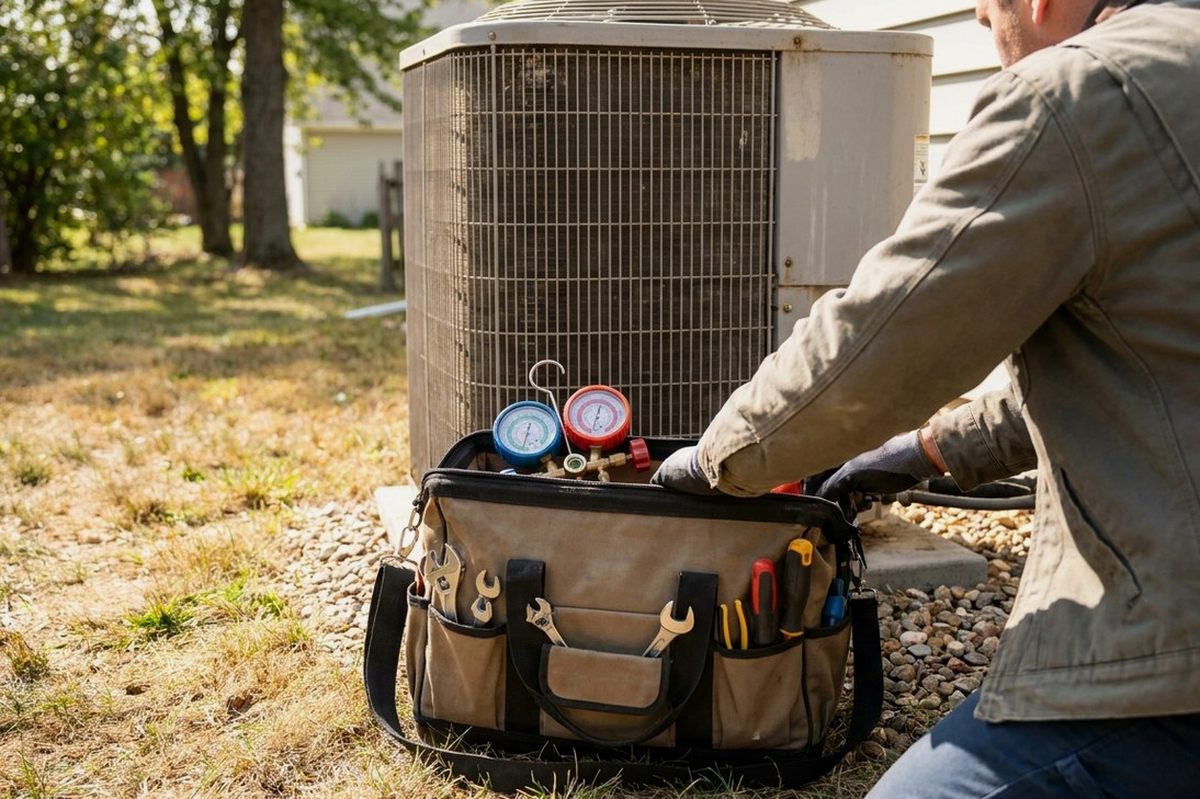
We start with what is actually broken, not what we assume. We check the thermostat call, the electrical side, refrigerant pressures, and the defrost cycle. Then we look at the rest of the system. If the outdoor coil is rotted and the compressor is drawing hard, one repair will be followed by another. If everything else reads clean and one part failed, we fix that part and move on. We also ask how the house feels. If certain rooms never got comfortable even when the system was healthy, the ductwork may be the real problem, and a new heat pump will not solve it.{
Honest Cases Where Replacement Wins
There are situations where we tell homeowners to stop spending. A failed compressor on an aging unit with an older refrigerant is usually the end of the line. So is a leaking indoor coil on a system where the outdoor unit is also worn. If the system has needed three separate repairs in two seasons, the pattern is telling you something. And if you are on propane with a dual fuel setup where the furnace side is also near the end, replacing both at once usually makes more sense than doing them a year apart. We will lay out both paths and let you choose.{
Related guides
Which Heat Pump Faults Are Worth Fixing — common questions
My heat pump ices up in winter. Is that a repair or a replacement?
Usually a repair. Light frost on the outdoor coil is normal and the defrost cycle clears it. Solid ice means a defrost board, sensor, or reversing valve issue, or low refrigerant. All are diagnosable and most are fixable.
Should I replace the indoor unit at the same time?
Often yes. The indoor coil and outdoor unit are designed to work as a pair. Replacing only one leaves you with a mismatched system that runs harder and rarely delivers the comfort you expected.
How long should a heat pump last around here?
It varies with maintenance, run hours and installation quality. Systems that get regular filter changes, clear space around the outdoor unit, and yearly checks tend to outlast ones that do not by a wide margin.
How it works
- Step 1
Tell us the symptom
Call or fill in the quote form and describe what changed. Warm air, no air, a smell, a noise, a breaker that keeps tripping. That detail tells us what parts to bring along.
- Step 2
We diagnose on site
We check the thermostat, the electrical side, airflow and the equipment itself before we quote anything. If the problem sits in the ductwork rather than the unit, we say so plainly.
- Step 3
We repair and explain
Most air conditioning repair and heating repair work finishes in one visit. We show you the failed part, explain what caused it, and tell you what to watch for next season.
- A real person answers
- Open 7 days
- Written quote before work starts
Why homeowners call us
- Propane and dual fuelPlenty of homes in our service area run propane heat or a dual fuel setup with a heat pump. We know how those systems switch over and why a bad changeover setting can leave you cold and burning fuel.
- Older houses, added ductworkFarmhouses often got ducts decades after they were built, run through crawl spaces and attics. When the equipment tests fine but rooms still fight each other, we look at the duct runs and static pressure.
- Repair before replacementA failed capacitor, a cracked wire, a clogged drain or a bad control board is a repair, not a new system. We tell you when the equipment is genuinely finished and when it is not.
- Plain talk on the phoneWe ask what the thermostat reads, whether the outdoor unit is spinning, and when it last worked normally. That two minute conversation often shortens the visit and keeps the repair cost down.
- All major brands, gas & electricCarrier, Trane, Lennox, Goodman, Rheem, York and more, as an independent company.
- Straight answersIf a system is not worth repairing, we say so, often right on the phone.
About this guide
When the easy checks change nothing, it's time for a tech
Describe what you found and we'll take it from there. Booking takes about a minute.
- A real person answers
- Open 7 days
- Written quotes
- All major brands
- Gas & electric
Rather not call? Get a free quote →